




Free preview

One: Birds That Eat Mud—16:00
The heat haze rising from the sun-baked asphalt made the streets of Tokio shimmer and warp in the evening light.
East Setagaya, where Route 246 and Route 3 intersected beneath the highway, buzzed with its usual unchanging clamor.
The same old scene played out: a uniformed police officer chatted with the owner of an illegally parked mobile hot dog stand while browsing the holographic menu display. In front of a motel with peeling paint prostitutes preparing for peak hours sat on the ground, applying cheap blush to their faces—there was nothing particularly noteworthy about this mundane sight.
Business people in suits who had finished work earlier than usual sat on a café terrace, discussing the rich aroma of Pequod Co.'s premium coffee—known for its slogan "A Rich Cup for a Rich Life"—completely unaware that it was actually brewed from cheap beans worth little more than a hundred yen per hundred grams.
But amid all this everyday chaos, only the interior of J. J. Jewelers—the jewelry shop run by sixty-eight-year-old Johnny Jones—was anything but ordinary.
Usually at this evening hour, Johnny would be sitting in the well-worn swivel chair he always kept behind the mahogany counter, watching his beloved cat Joanna stretch and yawn while listening to his favorite Wes Montgomery album.
But now Johnny stood with his wrinkled, liver-spotted hands raised to ear level. His prized cat Joanna was nowhere to be seen, and the shop echoed with the rough, angry voices of men.
The hooded man with his face hidden behind a mask pointed a submachine gun at Johnny while urging his two companions to hurry. From the skin and wrinkles visible on the man's wrists between his black gloves and long sleeves, Johnny could tell he was white and relatively young. The men's obvious panic helped Johnny regain a small measure of composure.
You'd better think twice about this. We've never been late on our protection payments, and the police have customers here. This shop isn't worth the trouble.
Johnny tried to keep his voice steady, and it seemed to work reasonably well.
Listen here, what you're trying to steal—that's stuff the local mafia bigshots buy to keep their wives happy. If they find out you took it, you won't get off easy.
Before Johnny could finish speaking, a different man from the one holding the gun smashed the showcase with the handle of a crowbar. The man beside him began roughly shoving merchandise into a duffel bag along with the scattered glass.
The people outside walked past the shop without showing any concern for Johnny and the others. Of course they wouldn't care, Johnny thought bitterly.
If only someone with a strong sense of justice would call the police—but even then, by the time an officer finished his cigarette and casually opened the shop door, the men would have long since escaped. After glancing at Johnny's corpse bleeding from a bullet wound to the forehead, the cop would probably just scribble "unfortunate accident due to elderly man's fall" in his report.
Johnny knew the men hadn't killed him yet not because of any dubious moral restraint they might possess, but simply because gunshots would force even the police to come investigate.
Johnny also understood that they ultimately intended to kill him for his jewelry, and that the overtime-averse police would actually prefer him dead if it meant avoiding the hassle of questioning.
The men were shouting loudly about something. Johnny couldn't understand what they were saying. It wasn't just because their excitement made them hard to hear—they weren't speaking Japanese or English at all. Johnny figured that these men speaking what sounded like Portuguese were probably newcomers who had just arrived in the city.
Following the massive influx of mafia after World War II, Tokio had become a criminal city where outlaws from around the world gathered. Hundreds of mafia groups and illegal organizations ruled their respective territories in this city, and countless scoundrels like these men continued to drift here.
This city of Tokio, where outlaws who had lost their place anywhere else in the world gathered, eventually came to be called Lostman's Camp.
The men shouting loudly were undoubtedly among such outlaws.
With each piece of jewelry the men tossed into their bag, Johnny felt his anxiety and panic fade as he grew calmer, and he understood this was rooted in resignation.
Most of Johnny's remaining thoughts were occupied with what would become of his beloved cat Joanna. That adorable girl who had such a weakness for sparkling jewels and gourmet meals—if only she could adapt to the harsh street life awaiting her after losing her master.
The more Johnny thought about Joanna, the more he felt his vision gradually blurring. Even knowing this was escapism, the sensation of mist enveloping his sight felt pleasant.
If only it could end like this, while wrapped in this comfortable sense of floating, Johnny thought.
As the men's voices faded into the distance, another voice brought Johnny back to reality.
Hmm, I don't think pink diamond earrings are quite your style, buddy.
The voice was cracked and mechanical. It was so out of place that Johnny wondered if he was finally starting to hallucinate.
The bizarre appearance of whoever was speaking only convinced Johnny further that this had to be a hallucination.
The figure—Johnny couldn't tell if it was male or female—wore an unusually long charcoal gray military coat. Their face was hidden behind a leather mask with a large protruding beak and goggles. A large hood was pulled deep over their head, leaving almost no gap with the mask and making even their hair color impossible to determine.
The distorted voice was probably caused by a microphone and voice modifier inside the mask's beak. Combined with the poor speaker quality, it was impossible to determine the person's age or gender.
Johnny wasn't the only one unsettled by this highly suspicious figure's appearance. The robbers couldn't hide their shock at the beak-masked stranger who had suddenly appeared either.
Oh, maybe it's a gift for your girlfriend? But I think you should work on your appearance before buying expensive presents—ski masks aren't exactly trendy these days.
The beak mask pointed at the hooded man who had been holding Johnny at gunpoint. Their flippant tone was so carefree it almost made you forget anything strange was happening at all.
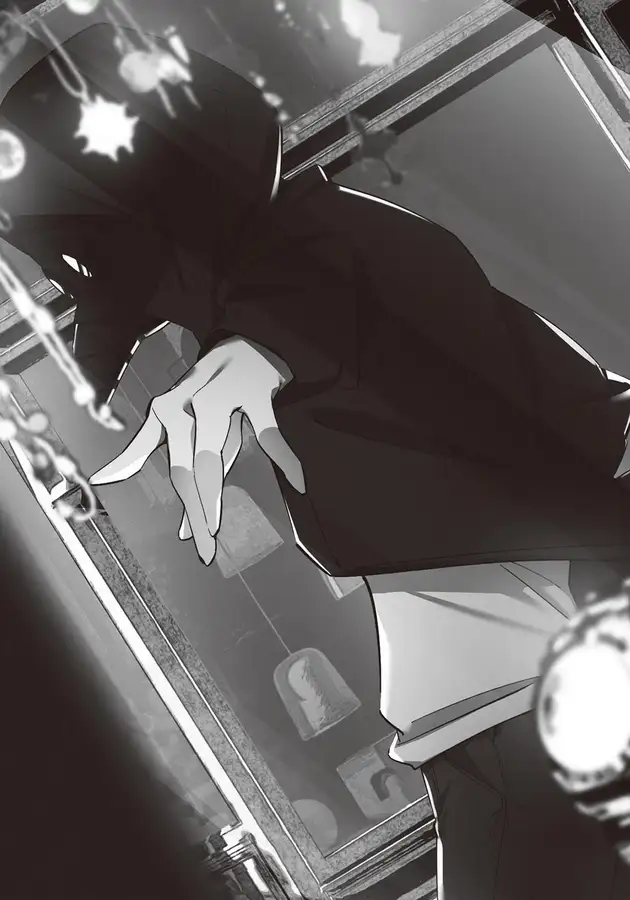
The stunned hooded man snapped back to his senses and swung his gun from Johnny toward the beak mask. It was a quick, decisive action, but the beak mask handled it with complete composure.
The beak mask grabbed the barrel of the man's submachine gun and slammed it hard against the counter. Both the submachine gun and the man's arm sank into the mahogany counter from the force of the impact.
The wooden counter surface rippled with a mercury-like sheen. While the man stared wide-eyed at this unbelievable sight, the beak mask casually pulled their own arm free.
Ah, but robbers do wear ski masks a lot, don't they? Are you all copying the same magazine or something?
To the right of the beak mask, who was still making irrelevant comments, the hooded man struggled to pull his arm free, but the counter held it fast and wouldn't let go.
From behind the beak mask, who maintained their nonchalant attitude, the man who had been smashing the showcase glass charged forward. He shouted something while swinging the crowbar in his hand, but he couldn't even close the less than two-meter distance between them before he fell down.
Fear written across his face, the man stared down at his right foot. His leg was entangled by vine-like metal that had extended from the floorboards.
Didn't your mother ever tell you that you'll trip if you run around in such a hurry?
The beak mask crouched down and peered at the man as they spoke.
With a sideways glance at the struggling man, the beak mask grabbed a branch from a nearby potted olive tree. The olive melted into a tar-like viscous mass, then transformed in the beak mask's hand into a single metal rope. The rope began moving as if possessed by its own will and bound up the second man.
If the men had been calm, they might have noticed the common thread in these mysterious phenomena. The mahogany counter, the floorboards, the potted olive tree—despite differences in processing and finishing, everything that had transformed into moving metal had originally been plants. However, they lacked the composure to recognize this pattern and stay alert.
The hooded man with his trapped arm was still struggling frantically to pull it free, and the embedded area was already bleeding internally. Meanwhile, the man with his leg entangled stared up at the beak mask, trying to say something but unable to form words, foam bubbling at the corners of his mouth.
The last remaining man stood in front of the shop's exit door and, after a moment of hesitation—likely debating whether to flee alone—quietly set down his bag and drew a pistol from his waistband with trembling hands. The large hood was blocking his view, so it seemed the beak mask couldn't see the man.
Johnny wondered whether he should warn the beak mask about the gun being pointed at them from their blind spot. He wasn't sure if this figure who had suddenly appeared was truly on his side.
That hesitation gave the man enough time to pull the trigger, and as a result, the beak mask didn't notice the threat bearing down on them.
Gunshots rang out through the shop. Of the six bullets fired in rapid succession, four missed their mark and pierced the floorboards, shattering a white porcelain vase in the process. The remaining two were fired directly at the beak mask's head and right arm. One hit around the cheek area, the other near the shoulder.
However, Johnny couldn't tell where the bullets had struck. There were two reasons for this: one was that Johnny had terrible farsightedness due to his age. The other reason was that the bullets couldn't even puncture the beak mask's coat and simply bounced off.
The beak mask slowly stood up and then remained motionless for a moment. The men and Johnny could only watch as the beak mask, who had been speaking so glibly just moments before, fell silent, and the shop was enveloped in an eerie quiet.
And in that moment when no one could move, the beak mask was the first to act. Once again, the beak mask slowly raised their right hand—clad in a dull-colored glove matching the coat—toward the ceiling. The coat sleeve fell slightly under gravity, revealing a glimpse of an unblemished, pale, slender wrist so beautiful that Johnny found himself captivated despite the tense situation.
That's exactly why Johnny didn't miss the moment when countless thin branches extended from the gap between the coat sleeve and wrist.
The extending dull-colored branches wrapped around the ceiling fan light, then entwined the shooter's legs and lifted him into the air.
The branches stretched further, bringing the suspended man's face level with the beak mask's. Johnny couldn't tell what the beak mask was thinking as they stared at the man.
Alright, that's it! Now then, I have a few questions for you guys.
The beak mask clapped their hands together as they spoke. They had already regained their earlier carefree demeanor.
Before the questions, you should take off that ugly mask—it's hiding your handsome face and ruining everything . . . actually, maybe you should keep it on. Sorry.
The beak mask removed the ski mask from the suspended man. What emerged was a blond, pudgy man whose face was covered in fear and snot.
W-who are you?! You monster!
Ugh, spit and snot flying everywhere . . . What am I? Do I look like a crepe vendor or something?
The man bellowed in heavily accented English, but the beak mask didn't seem bothered.
I'm the one with questions here. You guys—do you know anything about the mafia attack incident that happened at Yoyogi Central Park on June 27th, ten years ago?
For the first time, the beak mask's tone turned serious.
Johnny's memory was filled with events from ten years ago.
Back then, a massive mafia war had engulfed all of Lostman's Camp. It started with the arrival of Sid Evans, the Big Boss of the House of Orange, and hellish days dragged on for about three years—gunfights and assassinations everywhere, day and night. The scars from their violence, where personal profit mattered more than human lives, still speak through the bullet holes scattered throughout the city.
The endless bloodshed and gunpowder smoke finally ended seven years ago. A citywide ceasefire was brokered by Vito Greco, boss of the Fiorenza Family—the largest organization in the city—and Sid Evans.
Since then, while small skirmishes broke out here and there, no conflicts consumed the entire city. All the criminals chose to band together and sip brandy by the fireplace instead of sleeping in terror, dodging stray bullets on straw beds laid over piles of corpses.
The attackers in that incident were probably the Fiorenza Family. I'm hunting their boss, Vito. If you know anything about where Vito might be, any leads at all, tell me.
I don't know anything! I swear, I could swear on God!
Just so you know, lies won't help either of us.
The beak mask pressed the issue threateningly, poking the man's forehead with their finger. Johnny figured the incident was probably connected to one of the countless conflicts from the war.
It's useless to ask. They really don't know anything. By the look of them, they're newcomers to the city.
When Johnny spoke, the beak mask stared at the man for a while, then let their shoulders drop.
Looks like you're right . . .
The beak mask sighed and turned to face Johnny.
Do you know anything, old man?
Nothing useful I can tell you. Even if I knew something, there ain't a soul in this city who'd gossip about that man. Except for you, apparently.
If he spoke that name carelessly and, by some chance, word reached that man's ears and set him off—the consequences of that scenario terrified Johnny far more than being robbed at gunpoint.
The beak mask responded to Johnny's words.
You're right.
They let their shoulders drop once more. The gesture made Johnny sense genuine humanity in them.
If you're nursing some grudge against that man and hunting him for revenge, let me give you some advice—don't. There's no point wasting the precious years of your youth on something like that. And even if you did track down where he is, what then? Next morning, they'd just find your mask floating in Tokio Bay.
Johnny was just guessing about their youth, but judging from their mannerisms and the glimpses of smooth skin visible through gaps in their clothing, he figured he wasn't far off the mark.
It's not really about revenge, though.
The beak mask turned away, dismissing Johnny's words.
I just can't stand the injustice in this city. That incident—it's the worst injustice I've ever seen, so I want to catch whoever's responsible. I'll find Vito, get him to tell me the truth about what happened and who was behind it. If Vito's the one who ordered it, I'll arrest him on the spot. I'll make him face justice under the law. That's how I want to prove there's still order in this city. That's all I'm trying to do.
Johnny suddenly realized the beak mask was only about as tall as his grandchild. If this person really was the age Johnny suspected, he couldn't understand what drove them so relentlessly—Johnny had grown completely numb to what they called the city's injustice.
Metal ropes extended from the beak mask's coat sleeves once again and bound the men in an instant.
Well, I'm heading out now. These restraints will turn back into regular hemp rope in about thirty minutes, so call the police before then. Even they can't ignore criminals caught red-handed.
With that, the beak mask hurried away without giving Johnny time to offer thanks.
Johnny called the police as instructed, then sat in his swivel chair staring blankly at the struggling men. His beloved cat Joanna appeared from somewhere, rubbed her face against his shin, and jumped onto his lap.
Even while petting his adorable yet traitorous pet—the one who had abandoned her master and fled—Johnny couldn't shake the feeling that he'd been thrown into a different world. He gazed at the people passing by his shop, the trucks belching black smoke, and the dirty sign of the pub across the street. The scenery through the window felt like something happening on the other side of a television screen.
After a while, Johnny remembered a rumor he'd heard from a regular customer.
It was about a mysterious vigilante of unknown identity who would appear somewhere in the city from time to time, catch criminals, then leave without taking anything or asking for thanks—no one knew when they had first appeared.
* * *
She was running through a dark, empty alley.
She climbed the exterior walls of mixed-use buildings, jumped from rooftop to adjacent buildings, then descended back into alleys—repeating this pattern while searching for deserted places. In this city, alleys were the domain of vagrants and street gangs, making it difficult to find empty spaces.
She arrived at a narrow alley leading to a restaurant's back door, several hundred meters from the jewelry shop. Dirty rats were gathering around a pile of carelessly discarded black garbage bags.
Sitting on a peeling aluminum trash can to finally catch her breath, Mina Kamisu looked around, then roughly pulled off her hood and beak mask.
When she looked at the restaurant's window, she couldn't see inside due to black curtains, but instead saw the reflection of a girl with green eyes. Her unruly red hair inherited from her mother was stuck to her face with sweat. The oversized military coat covered her body down to her knees, hiding her figure—if you couldn't see her face, someone might mistake her for a boy.
The coat began to change. The hem visibly shrank to waist length while the glossy charcoal gray fabric turned khaki. But Mina's face showed no surprise or confusion at this sight.
The inside of the gloves gripping the leather mask was soaked with sweat, intensifying the discomfort that had settled in her stomach.
The image of the robbers she had just fought burned into Mina's mind. The paralyzing fear that struck whenever a large man charged at her, shouting, was something she could never get used to, no matter how many times she experienced it.
Behind the mask, she tried to hide her frightened expression, deliberately making light conversation to convince herself she was fine—but even after all that, her legs still trembled when faced with the actual situation.
She forced the mask and gloves into her pocket, then repeatedly clenched and opened her freed hands. Doing this made her feel like her body responding as it should was proof that she was still alive. But it also made her simultaneously aware that she was still shaking.
Sitting alone and trembling after everything was over had become routine for Mina, but today was particularly bad. She was deliberately sitting on the dirty trash can because otherwise she would have crumpled to the ground and probably wouldn't have been able to get back up.
That's why I hate guns . . .
Mina remembered the moment the third man shot at her. That had been a failure.
She always made sure to take down gun-wielding opponents first, and this time she had deliberately targeted the man with the submachine gun—but it was pointless if she overlooked the others. The result was that pathetic display.
When she realized she'd been shot, the sound of gunshots echoed in her head, and Mina was on the verge of clutching her head and screaming. She somehow managed to hold back at the last second, but her heart kept racing until she left the shop, and she desperately tried to keep anyone from noticing her trembling voice.
Every time a gun was pointed at her, every time she heard gunshots, the same scene always flashed through Mina's mind: her mother falling before her young eyes, struck by a stray bullet during the mafia conflicts.
Her mother wasn't even given time to grimace in pain or leave any words for Mina—she died with the same expression she'd had while talking to Mina. Ever since then, the memory of death that had burned into her heart would vividly resurface whenever her senses recognized anything gun-related, clawing at Mina's heart with sharp talons.
After her mother's death, a mysterious power manifested in Mina's body: the ability to transform plants she touched into controllable metal. This power worked on trees and flowers, of course, but even processed materials like cotton were affected by it—and it was precisely because of this ability that Mina could more than hold her own against grown men.
However, even with enough physical power at her disposal, her emotions couldn't keep up.
He called them newcomers, but I really wish that people would stop causing trouble the moment they arrive in this city.
She was just talking to herself, but by deliberately speaking aloud, Mina was trying to distract herself from her trembling.
Don't seek revenge—that's what the shop owner had said. To most people, Mina's pursuit of the Fiorenza Family and Vito probably looked exactly like that.
But Mina didn't want to hurt Vito, much less kill him. The incident that took her mother represented the ultimate injustice to her, which is why she wanted to get the truth from Vito, catch the mastermind—or him, if he was the mastermind—and make them pay under the law.
She wanted to judge the outlaws who had buried their past crimes and basked in prosperity—she who had suffered under them would condemn them according to proper law. By doing so, she wanted to prove that there was order in this city too.
Despite overcoming various obstacles and spending over a month gathering information while catching criminals, she still hadn't found any leads on where Vito might be.
What Mina knew about the incident was that the attackers were probably the Fiorenza Family, and Vito had likely commanded them. However, the only evidence she had was her memories from the time of the incident, and she was searching for something that could turn suspicion into certainty.
Mina understood well that her obsession with order was incomprehensible to the people living in this city. In their eyes, the robbers were probably far more understandable than she was. This was just that kind of place.
The robbers she'd caught earlier were probably in police custody by now. The city's police force was corrupt, but the only criminals officers would shield and overlook were mafia members operating in their jurisdiction. Even they claimed to conduct proper law enforcement for the public, so they wouldn't pass up the chance to safely arrest robbers caught red-handed.
I hope that shop gets back to normal . . .
If it was the kind of shop dealing in expensive goods that would attract robbers, the owner probably had some connection to the mafia, Mina thought. But that was just a consequence of circumstance. People didn't open shops because they wanted to deal with the mafia.
The criminals didn't care whether their targets wanted it or not—if it served their interests, they would extend their hand and force the other person to grasp it. And Mina knew they only released their grip once they had crushed every last bone.
The injustice of forcibly dragging people who wanted nothing to do with evil into the shadowy underworld that pervaded all of Tokio's Lostman's Camp—this was something Mina couldn't forgive. No matter how much fear assaulted her, the anger that never stopped screaming in her heart drove her body forward.
When she saw people casually harm others with indifferent faces, the emotion welling up from deep in her belly would override her fear. While this allowed her to fight terrifying criminals, she also felt reluctant to surrender herself to anger.
Anger was poor-quality fuel, and while it drove her body by flaring up, it also steadily wore down Mina's heart.
The heart was greedy and finicky—a troublesome thing that refused to respond to most other motivations. Even if she put on a flippant attitude in front of criminals to temporarily ignore her fear and anger, after everything was over like this, she had to face her heart that had only been looking the other way.
Her trembling was gradually subsiding, and just as Mina was thinking she should leave this unsanitary place, a man wearing an apron came out of the restaurant's back door.
Mina quickly pushed the mask deeper into her pocket, put on a smile, and waved. But the man just gave her a suspicious look, tossed the garbage bag he was carrying onto the pile next to her, and closed the door.
Mina sighed. He probably thought she was an orphan scrounging for garbage or a prostitute on break. It wasn't pleasant, but it was far better than having her mask seen.
Mina knew about the circulating rumors of a masked figure of unknown identity who went around taking down criminals. That was fine—nothing could be better than criminals fearing her. But she had to avoid her identity being discovered at all costs. Street gangs and dealers often had mafia managing them behind the scenes. If the cunning mafia figured out Mina's identity, just thinking about what methods they might use to corner her was terrifying enough to make her tremble.
Even the restaurant guy seems to dislike me, so I should just go home for today.
Mina started walking, speaking aloud had solidified her decision.
Emerging onto the street, Mina blended into the bustling crowd that was completely different from the back alley. Among the passersby, some had probably heard the gunshots the robbers had fired just moments before, but everyone was going about their daily routine as if nothing had happened—as if this was how this city was supposed to be.
Lostman's Camp is roughly divided into three zones based on security: Upper Site, Mid Site, and Lower Site. Mid Site, which includes East Setagaya where Mina currently was, is the largest of the three areas and is home to various residents: mafia members, employees working in the affluent Upper Site, independent shop owners, and criminals who had drifted in from overseas.
While security varies, even in relatively good areas, drug dealers and prostitutes brazenly work the streets at night. In poor areas, it's not uncommon for kidnappers to appear even during the day. Judging from how no one was making a fuss despite a robbery occurring, East Setagaya's security level was self-evident.
On her way to the station, Mina passed many people and was approached several times by drunks and pimps who spotted a girl walking alone, but no one truly cared about her in any meaningful way.
Of course they didn't. This was Lostman's Camp, a place forgotten by ethics and morality.
* * *
St. Monlith Girls' Academy, situated on a hill overlooking the Tamagawa River, was bathed in soft light from the slanting sun. Hymns could be heard from the chapel opposite the school building. The voices sparkled like falling crystals, praising the Lord—a perfect reflection of the girls' untainted youth.
When Mina reached the west wall of the academy, she made sure no one was around, then took out a key from her backpack and entered through the rarely-used service gate.
Mina was born in Lostman's Camp, lost her father at age four and her mother at age seven, leaving her an orphan. She had been living at the boarding academy across the Tamagawa River for ten years now.
Mina had always been a chronic truant. With help from her longtime roommate Misao Himemura, she first snuck out through gaps in the fence surrounding the academy seven years ago. As her body grew and squeezing through the fence became difficult, she borrowed a key from the office and made a duplicate for the service gate four years ago. It had been quite the adventure at the time, but looking back now, she had to admit she'd been reckless.
Even so, Mina couldn't bring herself to condemn her past self. Back then, she was constantly thinking about ways to reach Lostman's Camp across the Tamagawa River.
Tokio is naturally divided by the Tamagawa River. North of the Tamagawa lies Lostman's Camp, known worldwide as a city of vice and corruption, while south of the Tamagawa lies the area called Japantown, where those driven out by the mafia live.
Lostman's Camp became a cultural melting pot of diverse tastes and demands due to mafia business expansion and racial mixing. Meanwhile, Japantown—whose residents had grown more inward-looking due to their exile and pursued development focused on security—developed in completely different ways despite being separated by just one river.
The difference in security between the two was stark, but there was also a huge gap in economic development. Lostman's Camp, with its remarkable influx of people and businesses, thrived while Japantown's residents continued to migrate to safer cities with more job opportunities.
While there were variations in development within Lostman's Camp itself, the high-rise buildings competing to reach the sky in Upper Site and the constant bustle of people moving through the city day and night were sights never seen in Japantown.
Mina often heard elderly people who had moved to Japantown say things about how there were no tall buildings there, so one could see the sky clearly.
Mina had heard that this situation stemmed from the post-World War II occupation policies.
The mafia who arrived in Tokio at the same time that the Potsdam Declaration was implemented, bought off corrupt military officers and politicians, worsening public order. They then used the incompetence of the American and British governments as a pretext to move the capital to Kyoto under the pretense of rebuilding the governing structure through civilian organizations.
In the late 1950s, the yakuza protected Japanese people who couldn't relocate with the government and formed what would become known as Japantown south of the Tamagawa River, signing a mutual non-aggression pact with the mafia.
Currently, the only ways to cross the Tamagawa River are by taking trains that require boarding permits or using the underground freight tunnel, both of which are strictly controlled and not easily accessible to ordinary students traveling alone.
Ever since she began living in Japantown, Mina was constantly thinking about ways to cross the river alone, but she had only succeeded two months ago. After becoming somewhat skilled at controlling her ability, she successfully strung ropes under the railway bridge to traverse it.
Until then, Mina could only let anger smolder in her young heart, so her reckless unauthorized outings were probably unavoidable.
Once inside the academy grounds, Mina headed toward the brick incinerator behind the chapel.
There was no one around the facility, which was currently off-limits due to environmental concerns, but Mina carefully surveyed the area. She opened the red, rusted iron door of the incinerator, pulled out the bag she had stuffed into the chimney, and changed into the uniform she had stored there.
The woods surrounded her, and she could hear students' cheerful voices beyond the rustling trees swaying in the wind. Only then did Mina finally feel she had returned to safety.
Mina emerged from the woods and casually blended in with the students heading toward the dormitory. As she walked, responding to acquaintances who occasionally called out to her, she spotted Sister Martha, who also taught at the academy, standing in front of the dormitory.
Martha had clearly noticed Mina before Mina spotted her, and was staring intently at her. From that look, Mina could tell her unauthorized outing had been discovered, and Martha was waiting to give her a lecture.
Mina gave up and forced a smile onto her face, then raised her hand and approached Martha.
Aunt Martha. What are you doing out here? I know it's nice weather for some sun, but you should sit down for that, right? Come on, you're not getting any younger.
Miss Kamisu, how many times must I tell you to call me Sister when we're outside the dormitory?
Martha rubbed her forehead and sighed. She was the one who had raised Mina like a surrogate parent ever since she'd become an orphan at age seven.
Well then, Miss Kamisu? You snuck out of the academy again—where did you go on your little adventure today?
So her outing had indeed been discovered. Martha was always the first to notice when Mina snuck out. The fact that she cared so much filled Mina with both joy and guilt for causing her worry.
Adventure? What are you talking about? I was playing catch with the priest after school the whole time. You know how energetic he still is.
The priest has been in the infirmary ever since he hurt his back at noon today.
. . . Oh, um, I mixed that up. The catch was yesterday . . . Sorry, I had promised to bring a fashion magazine to a girl who's in the hospital where I volunteer.
This wasn't a lie. Right after leaving school, Mina had gone to the nearby hospital. After finishing her business there, she had simply taken a little detour. As someone who habitually skipped out and was used to being caught by Martha, Mina had prepared an alibi for just such an occasion.
. . . I'll believe that excuse this time. However, while that may be a good deed, it doesn't justify breaking the rules. You understand that, don't you?
Yes, you're absolutely right . . .
If Martha knew that where she had gone to break those rules was across the river in Lostman's Camp, a simple lecture wouldn't be nearly enough.
Besides, you said the same thing before and came back injured. A lady shouldn't carelessly harm her skin—I couldn't face your deceased parents.
The boys at the hospital always invite me to play basketball in the courtyard. But I'm such a klutz—you know that, don't you, Sister?
Of course I do. When I took you to Girl Scout camp long ago, you would trip when you walked, nearly drown when you swam, and hook your own lip when you went fishing. I can't tell you how many times my heart nearly stopped.
As if the stress from those days had come rushing back, Martha sighed again.
. . . Mina? Please stop worrying me like this. I understand that life at this academy is restrictive for you. In fact, I'm happy that you've become such a spirited young lady. But these rules are to protect you—you understand that, right?
. . . Yeah, I'm sorry.
Martha's expression softened into that of the woman who had raised her like a mother. As Martha knew well, when Mina first came here, she had been a deeply troubled girl who withdrew into her shell. It was understandable, given that she had just witnessed her mother's death.
Martha had cared for Mina more devotedly than anyone. The days spent with Martha had been so fulfilling that Mina often thought her present life would have been much bleaker without her.
Well then, I'll be going back. You behave yourself for the rest of the day, all right?
Yeah, sorry for worrying you. Thanks as always, Aunt Martha.
Martha started to tell Mina to call her Sister instead, but caught herself midway and left with an exasperated laugh.
After watching her go, Mina also passed through the dormitory doors. She was taking off her shoes at the entrance and changing into slippers when someone tapped her shoulder.
I saw you getting another lecture. You really shouldn't worry Martha so much, Mina.
I know, but this is just how it is. Besides, if you were watching, you could have thrown me a lifeline.
Despite Mina's resentful look, Misao Himemura flashed a bright smile.
Come on, that's not fair—I just happened to see from our room window. Besides, I help with schemes and cover stories, but we agreed that when you get caught, you deal with the consequences yourself.
Many of Mina's sneaking out strategies—making duplicate keys, hiding supplies in the incinerator—had been conceived by Misao, her roommate of ten years.
While Misao was a model student who held student council positions and was well-regarded by teachers and nuns, she secretly harbored a mischievous side that wouldn't shy away from recklessness or danger if it meant adding excitement to daily life.
But Mina, you've been going out a lot more lately, haven't you? If you get too careless and they become even more suspicious, it'll be a real pain, so keep it reasonable.
As Misao said, Mina had indeed been making trips to Lostman's Camp more frequently recently. Her frustration with the current situation—getting practically no useful information about her mother's case—was driving her to desperation.
Apart from the sneaking out, I'm against the river crossing too, you know.
Misao said this while lowering her voice so others wouldn't overhear.
You haven't achieved anything yet, have you?
Mina had told only Misao that her destination when she snuck out was Lostman's Camp. Misao also knew about the power within her. Otherwise—if she didn't know Mina could protect herself in emergencies—even Misao wouldn't have cooperated.
However, Mina had kept her vigilante activities secret even from Misao, her best friend. If Misao knew she was fighting armed men, it wasn't hard to imagine that she would refuse to cooperate out of worry.
She had something she absolutely needed to investigate about her mother's case, and she would never go near dangerous places. That's what she told Misao, and she had somewhat forcefully asked for her cooperation in covering for her.
Yeah, it's not going very well.
I understand you're anxious, but please don't do anything truly reckless.
Misao, who had also grown up at the academy, had lost both her parents in an accident during childhood. That's precisely why she could understand Mina—otherwise, she wouldn't have helped with the river crossing.
I'm not saying you have to tell me everything you're thinking. But if you have any troubles, I'll always listen. Okay?
Yeah, thank you.
Misao had always been skilled at maintaining appropriate distance with people. She would never approach when you wanted to be left alone, and would extend her hand just when you were longing for human warmth. Mina had been saved countless times by this natural sense of balance.
Oh, by the way, there was a letter stuck in our door—it was addressed to you this time, which is unusual. I left it on your desk.
For me? I wonder what it could be . . .
In this day and age of widespread paperless communication, Mina couldn't think of many reasons why she would receive a letter. She occasionally saw Misao receive love letters from female students who were fond of old-fashioned communication methods, but such correspondence rarely came her way.
After some light conversation, Mina parted ways with Misao, who had business in the student council room, and returned to the room they shared.
Most of St. Monlith Girls' Academy's buildings were converted from a silk factory built in the mid-Meiji period.
The student dormitory where Mina lived had apparently once housed many female workers. Though hot in summer and cold in winter, Mina was fond of the historic wooden dormitory with its character.
She dropped her backpack and sat on the bed, but heavy fatigue immediately washed over her, and she lay down still in her uniform. The fresh sheets that Misao had apparently changed along with her own gave off the soft fragrance of osmanthus.
Listening to the occasional sound of someone walking down the hallway through the door, Mina spent about twenty minutes in a daze. Time in Lostman's Camp always felt extremely long, and every time she returned, she experienced the strange sensation that her heart and reality were somehow out of sync.
Suddenly, Mina remembered the letter Misao had mentioned.
She sat up and looked at her desk, where there was indeed a carefully sealed envelope. Mina reached over from the bed and took the letter.
The plain white envelope bore no sender's name, and on the front was written in thin, neat ballpoint pen:
To Mina Kamisu
And nothing else.
The thought that this might be a love letter made Mina feel melancholic.
No matter who it was from, she didn't have the luxury to deal with such things right now. Still, she had to show sincerity toward whoever had gone to the trouble of sending her a letter.
With that thought, Mina broke the seal. The moment she saw the letter's contents, she realized how naive her assumptions had been and nearly wanted to punch herself.
I thoroughly enjoyed watching your robbery suppression at the jewelry shop. I've always thought it such a waste to hide your beautiful eyes behind that mask. I have something to discuss regarding your secret. I'll be waiting for you today at the designated location.
How? Why?
The more she thought about it, the harder her heart pounded. Mina clutched the letter and found herself looking around the room, even though she knew no one else was there. Just then, she heard someone walking past the door and let out a startled cry.
While waiting for the footsteps to pass, her thoughts raced wildly, as if they'd been violently stirred up.
Someone had discovered her activities in Lostman's Camp.
With her red hair and green eyes, Mina's appearance was striking. That's precisely why she wore a mask to hide her eyes and used a transforming hood to cover her entire head so her hair wouldn't show. She had also concealed her voice, body type, and anything else that could identify her as much as possible. Yet despite all that, she'd been discovered.
Thinking rationally, the sender had to be someone connected to the academy. The boarding school was surrounded by walls on all sides, making it difficult for outsiders to get in. Moreover, Mina couldn't believe that someone could slip into the dormitory—which was always under watchful eyes—to plant a letter.
But if it was someone from within the academy, it seemed even less likely they could have figured out Mina's secret in Lostman's Camp. Getting permission to leave the boarding school wasn't easy, which was why Mina had desperately researched and planned from a young age to devise ways to sneak out. She had finally managed to cross the river just two months ago, and even that was only possible because of the power dwelling within her body. She couldn't stand the thought of someone else easily copying her methods.
Mina knew she wasn't bold enough to ignore this letter and go on living as if nothing had happened. She would go meet the letter's sender. To convince herself of this straightforward conclusion, Mina spent some time thinking of logic to deceive her own heart and suppress her fear.
First, she absolutely couldn't ignore this letter no matter what. She couldn't just look the other way and casually wait for whatever might happen. Since the sender could get into the academy, there was no guarantee that Misao wouldn't be affected too. That had to be avoided at all costs.
Her second justification: perhaps the letter's sender knew something about the incident that killed her mother, or about Vito's whereabouts.
These two factors seemed like they could cast some haze over the fear dwelling in Mina's heart.
Of course, there was no certainty anywhere. Even so, it was barely sufficient reason to face the situation rather than live in fear of the next unknown terror.
Since her roommate Misao showed no signs of returning, Mina left the room.
Since her identity had been exposed, there was no point in disguising herself. In that case, it would be better to wear familiar clothes so she could handle any emergency.
Mina headed to the incinerator again and changed from her uniform into a cotton T-shirt and jeans—plant-based materials she could manipulate with her ability—then put on her military jacket. Her pockets contained her mask and cloth gloves, spare hemp rope, and a tablet. The tablet wouldn't help in a fight, but it served as a wallet and emergency communication device.
Too much gear would just get in the way, but she really wished she could prepare more tools if she was going to fight criminals. Unfortunately, Mina's finances depended on the meager allowance she received monthly from her parents' estate, managed by the academy, so she couldn't afford to be extravagant.
After stuffing her pockets with as many thick leaves as she could gather from the surrounding woods, Mina snuck out of the academy.
She walked for about ten minutes until she reached the railway bridge spanning the deserted riverbank. Mina took the letter from her pocket and read through its contents once more.
In addition to the message for Mina, the letter contained details about a meeting place—a motel in Lostman's Camp. The envelope also contained several banknotes with alphabet markings in the upper right corner and a written note instructing her to give them to the proprietor.
Growing even more suspicious of the sender who had deliberately chosen Lostman's Camp as their meeting place, Mina extended her right hand toward the railway bridge. The thin hemp rope hidden inside her jacket transformed into metal and extended from her sleeve, wrapping around the beams lined up on the underside of the bridge. She tugged on the rope several times to adjust its strength and flexibility.
Using the same method, she extended rope from her left hand and wrapped it around a point several meters ahead. When she released her right hand, Mina's body began swinging like a pendulum, pulled by gravity.
She repeated this process, crossing under the bridge like Tarzan. It was routine for her now, but in the beginning, the rope often wouldn't reach the beams or would snap midway, causing her to fall into the river repeatedly.
As she steadily crossed the river, Mina gazed at the scenery on the opposite shore.
From the base of the rust-red railway bridge, a sign erected by a street gang caught her attention.
Hey sugar, give us booze! My kingdom for booze!
Two: Neighbors on the Other Shore—18:00
After crossing the river, Mina headed for the train station. Unlike the train line that crossed the river, the railway that ran only within Lostman's Camp could be used without any problems by ordinary people.
She took the train and found a car with as few people as possible. Pulling her hood low over her face, Mina told herself to be even more vigilant.
When she looked at the scenery outside, the slum called Lower Site spread out below. Ramshackle buildings from illegal construction crowded together, and in the alleys you could see bonfires surrounded by squatters and prostitutes heading to the city center for solicitation.
Lower Site was considered the lowest tier area in Lostman's Camp, where many orphans who couldn't join specific organizations ended up forming street gangs. Most of the street gangs dreamed of making connections with the mafia and rising up.
Having lost her mother and become an orphan like them, Mina was placed in a boarding academy through the arrangements of someone whose face and name she didn't know. But when she thought that if circumstances had been different, she might have been living there too, she couldn't help but feel conflicted. Nobody chose to live in Lower Site.
Passing through Lower Site, the train entered the middle tier of Lostman's Camp, Mid Site.
The place Mina was directed to go to was a location within Mid Site that could hardly be called safe, even by generous standards.
When she reached her destination station, Mina got off the train. On the platform, elderly street vendors were setting up shops at regular intervals. She headed toward the exit without paying them any attention, but along the way, boys selling goods approached her.
They were all dressed in rags, their thin hands outstretched, begging for spare change. While Mina sympathized with their circumstances, she knew they were really trying to pickpocket unsuspecting passersby, so she picked up her pace to avoid them.
They usually targeted tourists and newcomers, but once they realized Mina wasn't an easy mark, they quickly moved on.
After walking about ten minutes from the station, Mina found her destination among a row of mixed-use buildings. The Bowler Hat Inn was a concrete motel with a sign featuring a swan wearing a bowler hat. Next to the entrance, identical signs lay scattered in a careless pile. They were all chipped and riddled with bullet holes—a testament to the motel's violent history that stirred uncomfortable memories in the dark corners of Mina's mind.
After taking several deep breaths to calm herself, Mina pushed open the motel's heavy door, staying alert to her surroundings.
The hallway beyond the entrance was lit by flickering pale fluorescent lights. The sterile mass-produced tiles covering the floor were chipped in several places. On the left side of the hallway stood a small wooden vanity with a broken vase on top—judging by the dust covering the scattered fragments, it had been broken for quite some time.
On the right side of the hallway was a door with a small window and a rickety registration stand beside it.
When Mina nervously peered through the window, she saw a small room about six feet square. An elderly man who appeared to be the proprietor sat in a metal chair, smoking a cigarette while reading a newspaper.
When Mina hesitantly knocked twice on the small window, dust from the glass swirled in the air.
The old man glanced at Mina and stroked his chin beard.
We're closed today. Go home.
He turned back to his newspaper.
Suppressing her anger at the obvious lie, Mina slipped the bills from the envelope through the gap in the small window.
The old man set his cigarette in the ashtray and picked up the bills, examining both sides.
Third floor, back room.
He picked up his cigarette again as if nothing had happened and resumed reading his newspaper.
She headed toward the stairs. The reality of where she was hit Mina again, and she thought about the person who had summoned her here. She had speculated about the sender's identity countless times since finding the letter. Soon she would have her answer.
On the landing between the second and third floors, one of the two fluorescent lights in the ceiling was dead, while the other hung precariously. The failing light made the evening glow streaming through the window seem even more pronounced in the dim space.
With each step up the stairs, though her body climbed higher, her heart felt the oppressive weight of sinking into a tar pit.
Drowning in fear and tension, Mina snapped back to awareness when she noticed a single drop fall onto her collarbone. Sweat from her forehead had run down her bangs, forming droplets that seemed to race downward, as if trying to escape whoever waited on the floor above.
Thinking she should wash her face, Mina turned back to the second floor and headed toward the shared restroom at the end of the hallway. Water was leaking from under the door, and from beyond came a woman's sultry voice and the intermittent sound of something being struck.
Mina let out a sigh and leaned against the wall.
What an absolutely awful place . . .
She knew no one was around to hear her complaint, but the stress building inside her made her feel like she'd throw a tantrum if she didn't voice at least one grievance.
She raised her face. Looking up, she saw no sky—only the sterile ceiling marked with water stains.
She understood—she hadn't really wanted to wash her face. She was terrified of going upstairs where she didn't know what awaited her. She had simply wanted an excuse to delay, even slightly, the moment when she would have to face whatever was waiting.
Slumping down, Mina hugged her knees and crouched. As she did, a longing to return to the academy welled up in her chest. Wouldn't it be fine to go back to the station, take the train, cross the river, and maybe buy a souvenir for Misao? Once fear had weakened her resolve, such thoughts arose one after another.
But no matter how many excuses she made to herself, the memory of her mother's death—visible through all her weak protests—would never allow Mina to turn a blind eye.
That's right, I decided. To catch the people spreading chaos in this city, I first have to catch whoever caused that incident. I decided for myself that I'd keep trying no matter how scared I get.
As if giving herself a pep talk, she slapped her cheeks twice with both hands and slowly stood up, using the wall for support.
She wiped the sweat from her forehead with her sleeve and headed toward the stairs once more. Her steps were still heavy, but this time she felt more determined. She passed through the landing illuminated by the evening light and finally set foot on the third floor.
The third-floor hallway had the same layout as the second floor. At the far right end of the hallway was a restroom, its door half-open. On the left side, three doors were evenly spaced.
She stood in front of the specified room, the door at the very back. The gray, undecorated door had an aluminum plate with a serif "C" mounted on its surface.
She took the mask from her pocket and put it on her face. As she fitted gloves onto her hands, the fibers of her khaki jacket were simultaneously affected by Mina's power and metallized, taking on a dull metallic color. The hem that reached her waist extended to cover her knees, and the body of the jacket also expanded to conceal her figure.
Since her identity seemed to be exposed, there wasn't much point in hiding her face or figure, but Mina's intention was more about switching her mindset. The mask held special meaning—not to hide her face from others, but to suppress her own weakness.
She held her breath and clenched her trembling hands into fists. Her right hand moved so slowly it seemed as if time had stopped, while her heartbeat grew faster and faster.
Steeling herself, she knocked twice. After the sound of striking the door echoed like a drumbeat in the quiet hallway, a single word came from beyond the door . . .
Come in.
And Mina's heart leaped again.
It was a calm, young man's voice. So not someone from the academy? Did she recognize it? No, she'd find out once she opened the door.
Steadying her trembling right hand with her left, she slowly turned the doorknob. Even though she could sense herself backing away, Mina pretended not to notice.
The interior of the small room was quite spartan. The tobacco-stained wallpaper was spotted here and there with dark red stains, the largest of which were about the size of a handbag—and she preferred not to imagine what had caused them.
In the center stood an amber-colored table with two wine-red leather armchairs flanking it, filling the air with the smell of mold. The chair in the back was frayed around the armrest, while the one in front was worn at the shoulder, and yellowed cotton batting protruded from both.
I apologize for calling you here so suddenly.
Only then did Mina finally notice the man standing by the window.
He was a shadowy figure. Even when she looked directly at him, there was something hazy about him, the sort of man who wouldn't catch your eye even if you rode the same train—like grains of sand scattered between asphalt cracks.
He was probably in his twenties, about 175 centimeters tall with an average build wrapped in a black suit. His black hair, dark brown eyes, and unremarkable features suggested he was likely Japanese, or at least Asian.
Please, come in. Ah, lock the door behind you. I would have liked to prepare some refreshments, but the tea here is terrible—I couldn't in good conscience serve it to a guest.
The man gestured for Mina to enter and sat down on the sofa. The sofa frame creaked as he settled in, and his body sank deeply into the cushions. Though his voice was clear, there was something about it that seemed to diffuse and blur before reaching her ears, making it somehow hard to make out.
As she entered the room, a small fragment of linoleum tile cracked underfoot with a sharp sound.
. . . You're the one who sent the letter?
Yes, and I apologize if I've startled you. I needed to make contact as discreetly as possible. Please, have a seat, and feel free to remove your coat if you'd like. It's still hot, despite being September.
Mina stood beside the sofa in her jacket and chose not to sit.
You needn't be so wary—I have no intention of harming you. But very well. The furniture here is falling apart anyway, hardly worth forcing someone to sit on.
Who are you? What's your purpose with that—
Mina clutched her coat collar as if to hide it.
The man looked slightly surprised by her words. Seeing that human-like expression, Mina realized once again that he wasn't a ghost or something supernatural.
How rude of me. I haven't introduced myself yet, have I?
The man produced a business card from his jacket and placed it on the table, offering it to her. It was plain white paper with just a name and contact information written in simple typeface—but Mina deliberately chose not to take it.
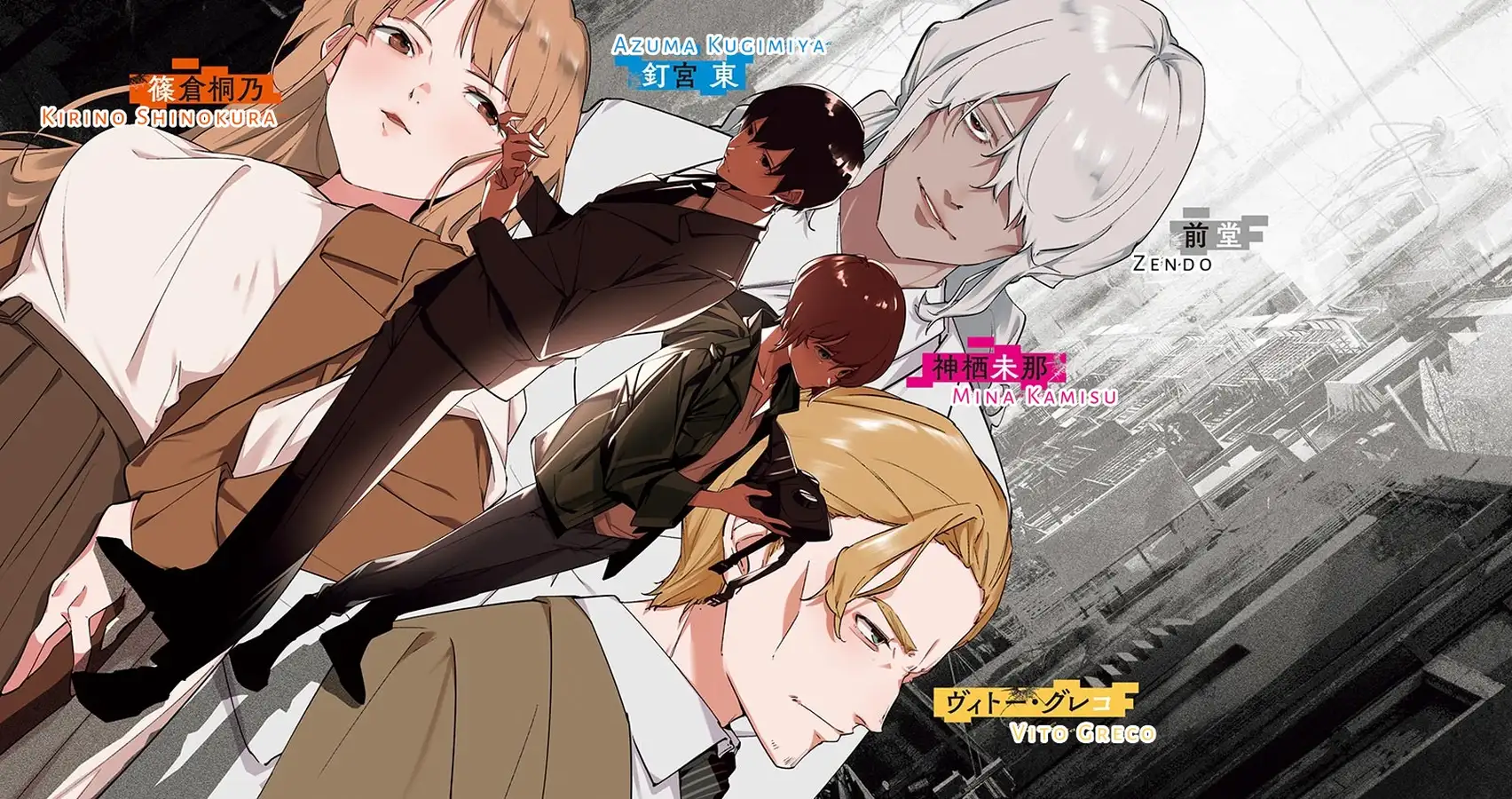
I'm Azuma Kugimiya. I run a freelance courier service in this city.
Courier service?
Yes. An intermediary who connects people to places, people to people—that sounds impressive, but in reality I'm just another delivery service like any other you'd find. This city has many packages that people prefer to keep out of sight, so there's plenty of demand for this kind of work. Like right now.
Despite talking about himself, his tone struck Mina as oddly detached, as if he were discussing someone else entirely.
The reason I asked you to come here today is exactly as written in the letter.
Azuma looked directly into Mina's eyes through her goggles as he spoke. She still couldn't read any emotion in his gaze.
I want to talk about your secret.
Not knowing how to respond to Azuma's words, Mina hesitated, looked down, and gave a small cough, then forced out her words while telling herself not to let her agitation show.
What could you possibly know about me?
Her voice came out strained and barely audible.
Well then, let's start there. It might even give you a reason to remove that uncomfortable mask of yours.
Paying no attention to Mina's barely concealed agitation, Azuma pulled a palm-sized gadget from his pocket and placed it on the table. A hologram screen materialized between Mina and Azuma, and he operated what looked like a companion device wrapped around his wrist.
In this city where rumors spread quickly, there's a topic that's capturing the public's interest right now.
Mina simply watched as the screen in front of her switched displays in response to Azuma's finger movements.
Apparently, a hero straight out of movies and comics has been going around taking down the city's villains. People started talking about it around the middle of last month, I believe. It began with small incidents—a man would leave his house and notice an unusual crowd gathered in an alley several blocks away. Curious, he'd go take a look and find men suspected of being car thieves tied up next to a sedan with broken windows that had apparently been burglarized during the night. Taped to the windshield was an old-fashioned Polaroid photo capturing the moment they smashed the window with a tool handle, along with a note addressed to the police.
The screen showed footage of a figure in a dull-colored coat that reached down to the knees and wearing a beak mask, soaring through the air in some back alley and literally mowing down attacking men. Every time the masked figure touched the potted plants or scattered debris around them, those objects began moving as if they were alive, capturing the men. The scene looked familiar. A few weeks ago, Mina had definitely been there.
There are all sorts of speculation about this person's mysterious powers. The most common theory is that they're the result of human experimentation by some organization. Nothing more than street gossip, really. There are groups in the city offering rewards to find this person, whose race, nationality, and even gender remain unclear. Though apparently there are a few odd souls searching for them just to say thanks.
Azuma swiped his device from right to left. The footage switched to the next clip. Mina couldn't look away.
The nickname is exactly what you'd expect from the appearance: "BeakHead." That's you, Mina Kamisu.
The screen showed a red-haired girl hurrying out of a different alley while glancing around cautiously. The girl had a khaki military jacket tied around her waist and was wiping sweat from her forehead.
She remembered it now. It was still August then, a terribly hot and humid night.
The letter delivered to her room, along with these two pieces of footage—she understood that this man had been tracking her movements. But she could still make excuses. This could never serve as definitive proof linking Mina Kamisu to BeakHead.
. . . Yes, I did help that girl when she was being harassed by those men that day. I received your letter from her.
Mina struggled to keep her voice from trembling.
Unfortunately, she and I are completely different people. We might have similar builds, but our clothes are different, and footage like that proves nothing. Besides, it's unreasonable to think some ordinary girl could stand up to men with guns.
Her words of denial echoed weakly from the speaker at her throat. Even knowing how strained they sounded, she still couldn't allow Mina Kamisu to be connected to the figure in the beak mask. The excuses she hastily offered were as patchwork and distorted as scraps of fabric sewn together, but Mina didn't have the luxury to worry about that as she frantically built her barricade of explanations.
Of course, this alone wouldn't be enough to definitively say this girl is BeakHead—that is, you.
Azuma's finger reached for the device again. Mina felt certain she could hear the sound of cracks forming in the thin ice she had desperately built up.
But how about this one?
The screen mercilessly displayed footage of Mina removing her beak mask after confirming no one was around.


